
The Need for the Framework
AI-based clinical decision support tools can help frontline providers identify risks and make better decisions, particularly where specialist services are scarce. However, a useful output improves care only when providers understand it, patients receive clear advice, and the health system can deliver the recommended care. Implementation science examines how to make these connections work in everyday practice. Without these connections, risk detection can leave patients without treatment, add work for providers, and produce records that never inform clinical decisions. This need became clear during the AI-enabled ultrasound pilot in Sindh, Pakistan. Bringing pregnancy screening into primary healthcare facilities addressed a diagnostic access gap, but its value depended on provider confidence, reliable supplies, appropriate referrals, and patient follow-up. Women needed understandable counselling and practical support to complete referrals. Existing implementation frameworks offer valuable guidance on adoption, context, and sustainability. EMBED-AI brings these insights together with the specific requirements of AI, including local validation, clinical oversight, understandable outputs, and monitoring after deployment.
The EMBED-AI Framework
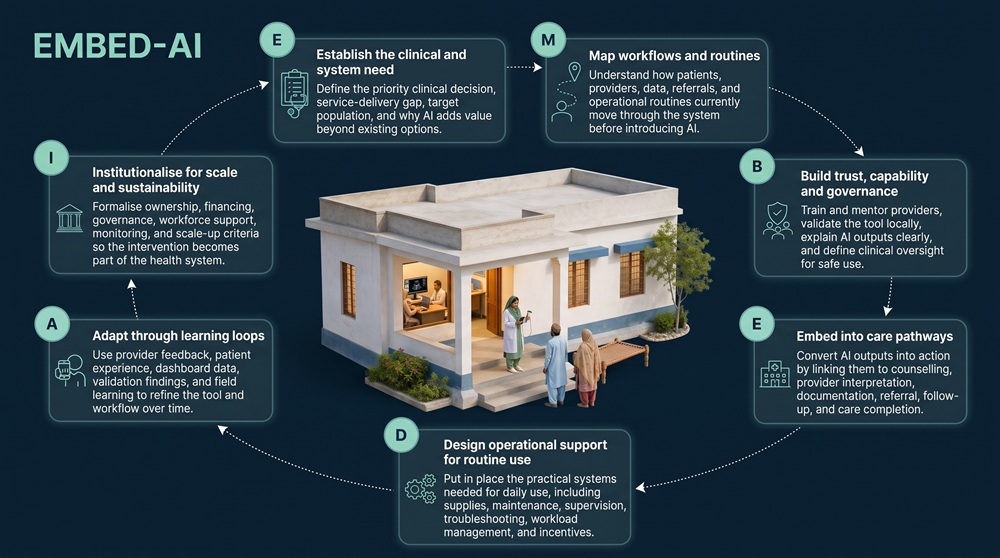
Developed at CERP from the Sindh pilot and established implementation science frameworks, EMBED-AI guides the introduction, routine use, expansion, and sustained delivery of AI-based clinical decision support. It connects the product, provider, patient, care pathway, data system, and responsible institution through seven stages. “Establish the clinical and system need” defines the service gap and the decision AI should support. “Map workflows and routines” examines how care, referrals, information, and daily tasks currently operate. “Build trust, capability, and governance” combines training, local validation, clear explanations, and clinical accountability. “Embed into care pathways” links outputs to counselling, clinical decisions, documentation, referrals, and follow-up. “Design operational support for routine use” addresses supplies, maintenance, supervision, and workload. “Adapt through learning loops” uses provider feedback, patient experiences, and service data to improve delivery. “Institutionalise for scale and sustainability” establishes clear ownership, financing, workforce support, and ongoing performance monitoring. These stages support repeated review: problems identified during delivery should inform earlier decisions. Throughout, providers retain clinical judgement, and implementation teams track whether identified risks lead to completed care. The framework translates implementation science into questions about who acts on an AI output, what support they need, and how care completion is verified.
Implications
For governments, EMBED-AI provides a basis for deciding which tools to adopt, where to introduce them, and when to expand their use. These decisions should consider clinical need, safety, equitable access, affordability, and the system’s ability to respond to recommendations. Implementers can use the framework to identify barriers, assign responsibilities, and make improvements during delivery. Product partners should design tools that providers can understand and use within existing services, supported by reliable technical assistance and compatible data systems. Donors should fund training, referral support, maintenance, and continued learning alongside technology. The accompanying Implementation Readiness Matrix helps partners assess whether essential conditions are present before introduction, expansion, or sustained delivery. Success should be assessed through safe use, completed care, patient outcomes, and institutional capacity. Together, these priorities help ensure that investment in AI strengthens routine healthcare and reaches people facing the greatest barriers to care.